The Himalayas, the veritable treasure trove of serenity & mysticism, rest peacefully on the lap of Nepal, a land sacred for both Hindus and Buddhists. If there’s one universal truth, it’s that the people of India & Nepal share an unbroken thread of culture and faith. And when it comes to the journey of the soul, Nepal is at the top of the list.
Since time immemorial, the spiritual pilgrimage between the two nations has shown the enduring ties. From Hindu pilgrimage sites like Pashupatinath temple in Kathmandu, Janakpur, the birthplace of Goddess Sita, to Buddhist worship sites like Lumbini, the birthplace of Gautama Buddha, these sites embody the essence of peace and compassion. These ancient Hindu & Buddhist pilgrimage sites in Nepal reflect a shared spiritual geography between the two nations where devotion, festivals, and rituals flow freely.
The same wind that carries Shiva’s chants from Pashupatinath also brushes against the Bodhi trees of Lumbini. Here, faith isn’t divided by religion; it flows like the rivers that stitch the two traditions together. Let’s take a closer look at some of the sacred places that make this land a living pilgrimage.
Kathmandu’s crown jewel, Pashupatinath Temple, has been standing tall for thousands of years. The 3,000 to 5,000-year-old Pashupatinath Temple in Kathmandu, flooded with devotees throughout the year, remains a timeless symbol of faith even today. The temple is at its busiest during the Maha Shivaratri festival, also referred to as “the Great Night of Shiva,” celebrated annually in February or early March. Many choose to spend the final days of their lives here, wishing to be cremated on its sacred soil so that their souls may be purified by the holy waters of the Bagmati River.
Tucked in the mystical Mustang Valley, Muktinath Temple is one of those rare spots where ancient tales from both Hinduism and Buddhism coincide with each other. Whether there are Devotees of Lord Vishnu or followers of Guru Rinpoche, all bow here together.
The stories around Muktinath are wild and wonderful. One legend says Lord Vishnu was cursed by Vrinda and turned into the sacred Shaligram stone. Whether you believe it or not, standing before those 108 water spouts, with icy air brushing your face, you’ll feel something shift inside.
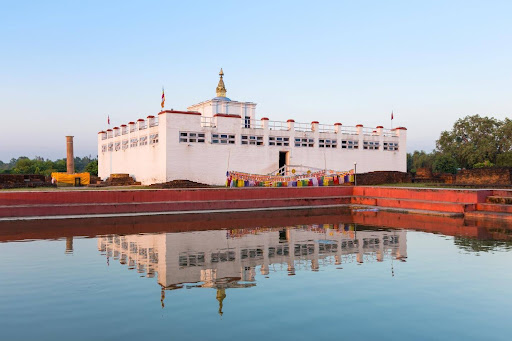
This place is pure calm. Lumbini, the birthplace of Gautama Buddha, feels like time itself has slowed down here. The white Maya Devi Temple,dedicated to Lord Buddha’s mother, with a very simple design and its whitish colour, reminds us that peace doesn’t need ornaments. Many pilgrims visit this temple for their morning prayers, and an iconic Bodhi tree is located near the temple.
Monks in maroon robes walk quietly through the gardens. Flags flutter above you like floating prayers. Even if you don’t meditate, you’ll catch yourself going quiet, it’s that peaceful.
Back in Kathmandu, the Boudhanath Stupa stands like a guardian of stillness. Its giant dome and Buddha’s painted eyes seem to look right through you, kindly but knowingly.
Walk around the stupa with locals, spin a few prayer wheels, light a butter lamp, maybe sip a cup of chai in one of the rooftop cafés nearby. This is spiritual travel in Nepal at its best, simple, heartfelt, and unfiltered.
Maybe what makes Nepal stay with you is its quiet warmth. The smiles, the slow mornings, the calm that settles on you without warning, it all feels deeply human. You don’t have to go looking for peace here; it’s there in the smallest things.
During your religious tourism in Nepal from India, you notice it everywhere, in a monk’s smile, the scent of marigolds at the shrines, and a passerby offering help with a kind word. These little moments are what you remember long after the journey ends.
And when you return home, Nepal doesn’t leave you behind. It stays in your thoughts, in your quiet pauses, in the way you start to look at life with a little more ease.
A journey to Nepal is never just about travel. It becomes a quiet conversation between devotion and discovery. For those on a Nepal spiritual pilgrimage from India, this land feels less like a foreign place and more like a reflection of home. The temples, the people, and the mountains together create a sense of belonging that words can’t fully capture.
Disclaimer: All information provided on this website is in good faith. While we endeavour to keep the information up to date and correct, we suggest everyone refer to the official website www.air.irctc.co.in for updated fares, offers & discounts.
